
.png) Book online
Book online
 Book via LINE
Book online
Book via LINE
AGA

This article has been written under the supervision of a Men’s Care Clinic physician. While every effort has been made to ensure medical accuracy, please consult a doctor regarding your individual symptoms.

AGA (androgenetic alopecia) medication is generally taken long-term, but dose reduction becomes possible as testosterone levels decline with age. Because AGA treatment is symptomatic rather than curative, hair loss will resume if finasteride or dutasteride is stopped. However, from the 50s onward, natural reductions in testosterone – the precursor of DHT (dihydrotestosterone) – create opportunities to taper the dose under medical guidance. Combination therapy starts at around 6,900 yen per month. AGA treatment is not a lifelong fixed regimen but a program optimized to each life stage.

“Do I really have to take AGA medication for the rest of my life?” “What happens if I stop taking my AGA drugs?” These are among the most common concerns of anyone considering treatment for androgenetic alopecia.
Here is the short answer: AGA medication is generally taken long-term, but you do not have to take the same dose forever. AGA (androgenetic alopecia) is treated symptomatically, so hair loss will begin to progress again if you stop taking finasteride or dutasteride. On the other hand, testosterone naturally declines with age, which means that dose reduction or even drug holidays become realistic options for many patients over time.
This article explains the truth about AGA treatment duration, the characteristics of each class of medication, what happens when you stop, age-based dose-tapering strategies, a full cost simulation if treatment is continued for life, and practical tips to stay on therapy comfortably. The content has been updated from the original 2021 publication with the latest evidence through 2026, so we encourage you to read through to the end.



The honest answer to “Does AGA treatment continue for life?” is “Essentially yes, but you do not have to maintain the same intensity forever.” AGA is a progressive form of hair loss, and controlling it with medication is a symptomatic approach – conceptually similar to using antihypertensives for high blood pressure or antihistamines for allergies.
In other words, while you are taking the medication, hair loss is suppressed; if you stop, thinning resumes. That may sound discouraging, but AGA treatment has an important advantage: because production of the causative hormone decreases with age, dose reduction and dosing-interval adjustments become feasible over time. We will examine this in detail later in the article. You can also find more information on AGA treatment details.
The single most important concept for understanding AGA therapy is that it is “symptomatic treatment.” AGA medications do not eradicate the root cause of hair loss; rather, they continuously block the mechanism that drives thinning, thereby suppressing the visible symptoms.
The mechanism of AGA can be summarized as the following cascade:
How AGA hair loss progresses
Step 1. Testosterone (the main male androgen) in the bloodstream reaches the capillaries of the scalp.
Step 2. In the frontal and crown regions, 5-alpha reductase binds to testosterone and converts it into DHT (dihydrotestosterone).
Step 3. DHT binds to androgen receptors in the dermal papilla cells, triggering hair-loss signaling.
Step 4. The anagen (growth) phase of the hair cycle is shortened, so hairs transition to catagen/telogen before they can grow thick.
Step 5. As a result, fine, short hairs increase and visible thinning develops.
Finasteride and dutasteride block step 2 by inhibiting 5-alpha reductase and suppressing DHT production. Minoxidil improves blood flow around hair matrix cells, supporting growth. None of these drugs eliminates 5-alpha reductase itself, so when the medication is stopped, DHT production resumes and hair loss recurs.
In short, when you stop AGA medication, “you gradually return to your pre-treatment trajectory.” That said, the speed of regression varies, and in most cases the decline unfolds gradually over several months to about a year.
AGA treatment duration is easier to grasp when divided into “time to feel the effects” and “time needed to maintain the results.” The typical timeline is shown below.
| Timeframe | Treatment Phase | Main Changes |
|---|---|---|
| 1-3 months | Initial (no visible effect yet) | Initial shedding may occur (temporary increase in hair loss). DHT suppression has begun but the hair cycle has not yet produced visible change. |
| 3-6 months | Onset of effect | Patients notice reduced shedding. Vellus and fine hairs begin to thicken. Photo comparisons start to show visible differences. |
| 6-12 months | Improvement | Patients feel that hair volume has increased. The hair cycle continues to normalize, and density improvements become obvious. |
| 1-3 years | Stable phase | Effects plateau and stabilize. Many patients transition to “maintenance therapy” at this stage. |
| 3 years and beyond | Maintenance / optimization | Focus shifts to preserving current density. Dose reduction may come into view depending on age and hair status. |
Regarding treatment duration, the Japanese Dermatological Association’s Clinical Practice Guidelines for Male and Female Pattern Hair Loss (2017) recommend continuing finasteride for at least 6 months. Clinical data show improvement in approximately 78 percent of patients after three years of continuous therapy, indicating that early initiation and long-term adherence are the keys to maximizing AGA treatment outcomes.

AGA medications fall into three major categories: finasteride (Propecia), dutasteride (Avodart / Zagallo), and minoxidil. Because their mechanisms of action differ, their treatment durations and timelines of effect also differ. In this section we look at each drug in detail.
Finasteride is the most widely prescribed first-line oral medication for AGA worldwide. It selectively inhibits type II 5-alpha reductase, reducing DHT production by approximately 70 percent and normalizing the hair cycle. See also our article on finasteride in detail.
| Item | Details |
|---|---|
| INN (generic name) | Finasteride |
| Originator brand | Propecia |
| Mechanism | Type II 5-alpha reductase inhibition; suppression of DHT production |
| Standard dose | 1 mg once daily (may start at 0.2 mg) |
| Onset of effect | Reduced shedding felt within 3-6 months |
| Finasteride treatment duration | Minimum 6 months of continuous use recommended. Improvement observed in approximately 58 percent at 1 year and 78 percent at 3 years. |
| Main adverse effects | Decreased libido (1-5 percent), erectile dysfunction (under 1 percent), hepatic impairment (rare) |
In principle, finasteride is taken for as long as the patient wishes to maintain the effect. If finasteride is stopped, the pre-treatment shedding pattern tends to return within several months to about six months. Because the risk of losing hard-won hair gains is especially high if treatment is stopped within the first three years, we strongly recommend continuing at least until the stable phase is reached.
Many finasteride generics are available, offering substantial savings compared with branded Propecia. At Men’s Care Clinic, we prescribe a combination drug with minoxidil for 6,900 yen per month.
Dutasteride is an oral medication with a broader 5-alpha reductase inhibitory profile than finasteride. Whereas finasteride inhibits only type II, dutasteride inhibits both type I and type II, so in theory it suppresses DHT production more powerfully. For more information, see dutasteride in detail.
| Item | Details |
|---|---|
| INN (generic name) | Dutasteride |
| Originator brand | Zagallo (Avodart) |
| Mechanism | Inhibition of both type I and type II 5-alpha reductase; stronger DHT suppression |
| Standard dose | 0.5 mg once daily |
| Onset of effect | 3-6 months (similar to or slightly faster than finasteride) |
| Dutasteride treatment duration | Minimum 6 months. Data suggest improvement beyond that achieved with finasteride during long-term continuous use. |
| Main adverse effects | Decreased libido (3-5 percent), erectile dysfunction (1-3 percent). Long half-life (approximately 3-5 weeks). |
Like finasteride, dutasteride is designed for long-term use, but its very long half-life of roughly 3-5 weeks is a distinctive feature. Compared with finasteride (half-life of about 6-8 hours), the drug remains active in the body far longer after a missed dose. Even so, AGA progression ultimately resumes, so “longer half-life does not mean safe to stop.”
Dutasteride is often prescribed for patients who did not achieve sufficient results with finasteride or whose AGA has progressed further. Because the optimal choice depends on scalp condition and individual factors, the drug should be selected in consultation with a physician.
Minoxidil approaches AGA differently from finasteride and dutasteride. Originally developed as an antihypertensive, it dilates blood vessels, improves scalp circulation, and delivers nutrients to hair matrix cells, thereby promoting hair growth. Both topical (solution) and oral (tablet) formulations exist, and how long to continue minoxidil depends on the form and severity of symptoms. See also minoxidil in detail.
| Item | Topical minoxidil | Oral minoxidil |
|---|---|---|
| Usage | Apply directly to the scalp twice daily | Oral, once daily (2.5-5 mg) |
| Onset of effect | 4-6 months | 3-6 months |
| Notes | OTC versions exist (e.g., Regaine). Limited side effects. | Stronger effect than topical. Requires a prescription. |
| Adverse effects | Scalp itching, contact dermatitis | Hypertrichosis, palpitations, edema (periodic tests are important) |
As with the other drugs, minoxidil should be continued for as long as the effect is desired. Finasteride and dutasteride are defensive drugs that block DHT production, whereas minoxidil is an offensive drug that drives new hair growth. Using the two together maximizes AGA treatment outcomes.
At Men’s Care Clinic we prescribe a finasteride plus minoxidil combination drug, delivering both defense and offense in a single once-daily tablet. Compared with purchasing the two separately, it costs less and reduces the risk of missed doses.
Here is a side-by-side view of finasteride, dutasteride, and oral/topical minoxidil across treatment duration, efficacy, cost, and side effects. Use it as a reference when choosing your regimen.
| Item | Finasteride (Propecia) | Dutasteride (Zagallo) | Oral minoxidil | Topical minoxidil |
|---|---|---|---|---|
| Action | Type II 5-alpha reductase inhibition | Type I plus type II 5-alpha reductase inhibition | Vasodilation, activation of hair matrix | Vasodilation, activation of hair matrix |
| Main effect | Suppresses hair loss (defense) | Suppresses hair loss (strong defense) | Promotes regrowth (offense) | Promotes regrowth (mild offense) |
| Typical time to notice effect | 3-6 months | 3-6 months | 3-6 months | 4-6 months |
| Recommended duration | Minimum 1 year; continue if effective | Minimum 1 year; continue if effective | Consider dose reduction after regrowth target is met | Long-term use recommended |
| Potential for dose reduction | May reduce to 0.2 mg in maintenance phase | May switch to finasteride in maintenance phase | Can transition to topical form | Concentration and frequency can be adjusted |
| Typical monthly cost | 3,000-8,000 yen | 7,000-12,000 yen | 5,000-10,000 yen | 3,000-7,000 yen |
| 30-year total | About 1.08-2.88 million yen | About 2.52-4.32 million yen | Limited if used only during regrowth phase | About 1.08-2.52 million yen |
| Main adverse effects | Decreased libido (1-5 percent) | Decreased libido (slightly higher) | Palpitations, edema, hypertrichosis | Scalp itching, contact dermatitis |
| MCC price | Combination drug from 6,900 yen/month | Combination drug from 6,900 yen/month | Please inquire | Please inquire |
*MCC = Men’s Care Clinic. The combination drug bundles finasteride and minoxidil at one price with pay-as-you-go billing. See our Men’s Care Clinic price list for the latest figures.

“What happens if I stop AGA treatment?” is a major concern for both current patients and those considering treatment. This section explains what occurs when you stop AGA medication, and introduces the important middle-ground option of AGA dose reduction instead of complete cessation.
If AGA medication is stopped completely, the rate of hair-loss recurrence is essentially 100 percent. This is because AGA is a progressive, genetically and constitutionally determined form of hair loss, and the drugs are only suppressing DHT production.
The typical trajectory after discontinuation is as follows:
| Time after stopping | Change in hair volume |
|---|---|
| 1-3 months | DHT suppression in the body gradually fades. Visible change is still limited. |
| 3-6 months | Patients begin to notice increased shedding. Hairs start to thin. |
| 6 months to 1 year | The rate of progression returns to pre-treatment levels. Thinning becomes visible on the crown and hairline. |
| After 1 year | Hair loss reaches the level it would have been at if treatment had never been started. |
A critical point to note is that the outcome is not “returning to your pre-treatment state,” but “progressing to the state you would have been in if untreated up to the present.” In other words, if you started treatment at age 30 and stopped at 35, you will not revert to age-30 hair; you may move toward the thinning pattern of a 35-year-old who had been progressing for five years untreated. The longer AGA therapy has been continued, the greater the risk at the moment of discontinuation, so casual self-discontinuation is strongly discouraged.
The choice is not limited to stopping completely or continuing the same dose indefinitely. AGA dose reduction, lowering the dose or frequency, is an intermediate option that has attracted attention in recent years as part of long-term AGA management.
Representative dose-reduction patterns include the following:
Common dose-reduction patterns
Pattern A. Lower the dose: finasteride 1 mg to 0.2 mg
Pattern B. Adjust frequency: every day, every other day, or three times a week
Pattern C. Switch medication: dutasteride to finasteride (milder action)
Pattern D. Shift from oral to topical: oral minoxidil to topical minoxidil
Crucially, dose reduction must always be done under a physician supervision. Self-directed dose cuts or skipped days can destabilize hair volume that has taken years to achieve. At Men’s Care Clinic, we propose individualized dose-reduction plans based on regular follow-ups that monitor hair density and scalp condition.
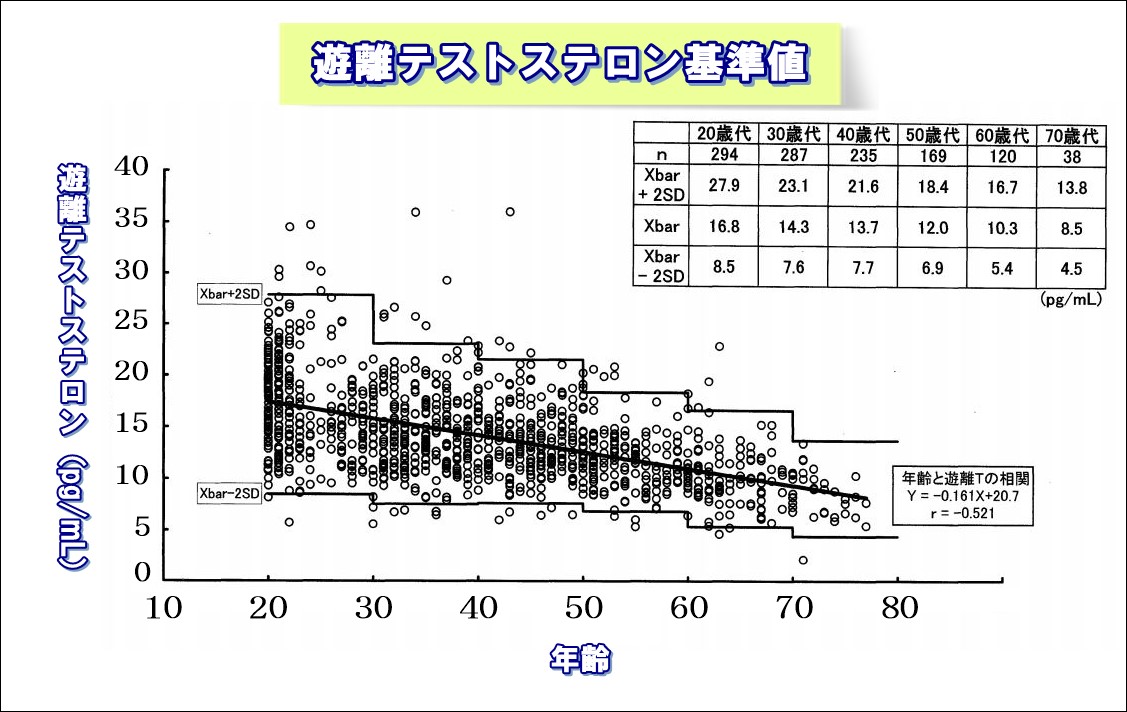
If the idea of lifelong treatment feels heavy, here is some reassuring news. Testosterone, the precursor of DHT (the causative hormone in AGA), naturally decreases with age. In other words, as you get older, DHT production also tends to decline, and the driving pressure behind AGA progression gradually weakens.
In men, testosterone, particularly the biologically active free testosterone, peaks in the 20s and then declines by approximately 1-2 percent per year. According to data from the Japanese Urological Association, reference ranges for free testosterone shift as follows.
| Age range | Free testosterone reference (pg/mL) | Implication for AGA |
|---|---|---|
| 20s | 8.5-27.9 | Before age-related decline. DHT production is active and AGA tends to progress. |
| 30s | 7.6-23.1 | Slightly lower, but still ample. A time when AGA treatment responds well. |
| 40s | 7.7-21.6 | Further decline. AGA progression may begin to slow. |
| 50s | 6.9-18.4 | Marked decrease. DHT production drops; dose reduction becomes a realistic consideration. |
| 60s and beyond | 5.4-16.7 | Substantially lower. AGA driving pressure weakens further, and additional reductions in maintenance dose are possible. |
The graph above shows age-based reference values for free testosterone. The upper limit in the 60s is roughly 40 percent lower than in the 20s. As testosterone falls, the amount of substrate available to 5-alpha reductase for conversion into DHT also falls. This is the rationale behind the AGA treatment concept of “aging equals an opportunity for dose reduction.”
Building on these testosterone trends, the following is an overview of optimal AGA treatment strategies by age. The earlier AGA treatment is started, the more options you have, including easier future dose reduction.
| Age range | Treatment phase | Recommended strategy |
|---|---|---|
| 20s | Early intervention | Early treatment is the greatest advantage. While follicles are still healthy, start combined finasteride plus minoxidil to cover both defense and offense. Think of it as banking future hair volume and stopping AGA progression at the earliest stage. |
| 30s | Active treatment | The main AGA treatment phase. Continue oral therapy to maximize effects while improving lifestyle habits in parallel. If finasteride is insufficient, switching to dutasteride is an option. |
| 40s | Maintenance / optimization | If hair volume is stable, discuss adjustments to a maintenance dose with your physician. Periodic blood tests can track testosterone and inform the feasibility of dose reduction. |
| 50s and beyond | Dose reduction / simplification | Leverage the natural fall in testosterone to attempt stepwise dose reduction, e.g., finasteride 1 mg to 0.2 mg, or daily to alternate-day dosing. Adjust carefully while monitoring hair volume. Some patients can maintain results with topical minoxidil alone. |
The key takeaway is that AGA treatment is not truly “for life” but rather “optimized to each life stage.” You do not have to carry the same intensity from your 20s into your 50s; the regimen can be adjusted flexibly to match physiological changes. Reframing treatment from taking medication forever to continuing the regimen that fits me today can meaningfully lower the psychological barrier to care.

Because AGA treatment tends to run for many years, the big question is: what is the total cost of AGA treatment? We answer “How much does AGA treatment cost if continued for life?” with concrete numbers. Understanding the monthly AGA cost and the total expense lets you design a sustainable treatment plan.
The cost of AGA treatment varies significantly by drug, formulation, and clinic. The figures below reflect typical market rates as of 2026.
| Medication | Typical market rate (monthly) | Men’s Care Clinic (monthly) |
|---|---|---|
| Finasteride (generic) | 3,000-8,000 yen | Prescribed |
| Dutasteride (generic) | 5,000-10,000 yen | Prescribed |
| Oral minoxidil | 5,000-10,000 yen | Prescribed |
| Finasteride plus minoxidil combination drug | 10,000-20,000 yen | From 6,900 yen |
| Topical minoxidil (5 percent) | 3,000-7,000 yen | Prescribed |
Let us simulate the cost of AGA treatment if continued for life. Assume that treatment begins at age 30 and continues for 40 years through age 70.
| Scenario | Monthly | Annual | 40-year total |
|---|---|---|---|
| Typical clinic (separate finasteride plus minoxidil) | 15,000 yen | 180,000 yen | About 7.2 million yen |
| Men’s Care Clinic (combination drug) | 6,900 yen | 82,800 yen | About 3.31 million yen |
| Men’s Care Clinic plus dose reduction from the 50s | 6,900 yen, reduced stepwise | 82,800 yen, reduced | Under approximately 2.5 million yen |
At typical market rates, 40 years costs about 7.2 million yen, roughly 180,000 yen per year. In contrast, the Men’s Care Clinic combination plan comes to approximately 3.31 million yen over 40 years, and adding a dose-reduction strategy from the 50s onward can bring the total to under 2.5 million yen. That is comparable to a monthly mobile phone bill, so the cost is not out of reach for most patients.
Because AGA treatment is long-term, it matters to keep the monthly cost as low as possible. The following points deserve attention.
5 ways to reduce AGA treatment costs
Tip 1. Choose a combination drug: a single tablet combining finasteride and minoxidil is substantially cheaper than receiving them separately. The Men’s Care Clinic combination drug starts at 6,900 yen per month.
Tip 2. Use AGA online consultations: see how online consultations work to save on transport costs and time. Men’s Care Clinic supports both in-person and online visits.
Tip 3. Choose a pay-as-you-go AGA clinic: pay-as-you-go means no annual contract or loan; you pay only for what you use. There are no cancellation fees if you pause or restart treatment.
Tip 4. Use generic medications: finasteride generics are as effective as Propecia but can cost less than half the price.
Tip 5. Prevent severe progression through early treatment: once AGA has advanced, stronger (and more expensive) medications or surgical options such as hair transplants may become necessary. Early AGA treatment helps reduce total costs.
Men’s Care Clinic offers pay-as-you-go billing, no expensive course contracts or annual loans. Even patients who want to try a single month can start comfortably.

AGA treatment is more like a marathon than a sprint. Rather than being distracted by short-term results, it is important to design a regimen you can sustain comfortably. Here are concrete tips for continuing AGA treatment for the long haul, along with an overview of how Men’s Care Clinic supports you.
To get the most from AGA medications and maximize the prospect of future dose reduction, it is essential to understand the link between lifestyle and hair loss and to care for your hair from within daily life. Do not rely on drugs alone; support AGA treatment from the inside out.
5 lifestyle habits that boost treatment results
Habit 1. High-quality sleep (7-8 hours): growth hormone is secreted during sleep, supporting repair of hair matrix cells and hair growth. The deep non-REM sleep in the first three hours is especially important. Avoid smartphones before bed and maintain a regular sleep rhythm.
Habit 2. A balanced diet: the synthesis of keratin, the main component of hair, requires protein, zinc, and B-group vitamins. Consciously eat oysters, liver, eggs, and soy products, and moderate excess sugar and fat.
Habit 3. Moderate aerobic exercise: walking or jogging for about 30 minutes three times a week improves systemic circulation and delivers nutrients to the scalp. Exercise also lowers the stress hormone cortisol, indirectly helping prevent hair-cycle disruption.
Habit 4. Stress management: chronic stress can lower testosterone and disturb the hair cycle. Even if you cannot eliminate work or relationship stress, having your own relaxation practice, such as hobbies, meditation, or deep breathing, is meaningful.
Habit 5. Proper hair care: shampoo once a day, pre-rinsing with lukewarm water. Do not scrub the scalp roughly; massage gently with the pads of your fingers. Dry about 80 percent with warm air, then finish with cool air to minimize damage to hair and scalp.
Lifestyle improvements are highly effective as an adjunct therapy for AGA. The lifestyle-hair loss connection is close, and reviewing your overall habits, not only taking medication, can raise the ceiling of your treatment results. Younger patients in their 20s and 30s who establish good habits now can meaningfully improve the odds of preserving hair volume and reducing medication in the future.
At Men’s Care Clinic, we have built the following framework to make it easy for patients to stay on AGA treatment.
| Feature | Details |
|---|---|
| Clinics and access | Shimbashi, Akihabara, and Omotesando, three clinics, all within a 5-minute walk of the station. |
| Online consultation | AGA online consultations supported. See a physician from home; medication is shipped to you. |
| Payment | Pay-as-you-go. No expensive course contracts or loans. |
| AGA combination drug | Finasteride plus minoxidil combination drug from 6,900 yen / month. |
| Partner hospital | Partnered with Toyosu Hospital for peace of mind when blood tests or detailed workups are needed. |
| Follow-up | Regular scalp photography to quantify efficacy, also used to judge the right timing for dose reduction. |
The two most important factors for staying on AGA treatment are ease of attendance and cost that fits your life. Men’s Care Clinic supports long-term adherence through a four-channel setup, three in-person clinics plus online, and a pay-as-you-go pricing structure. If you just want to talk first, please feel free to start with a free consultation.
Here are common questions about AGA treatment duration, cost, and dose reduction.
A. Because AGA is a progressive form of hair loss, thinning resumes if treatment stops. However, you do not have to take the same dose forever. Treatment is broadly divided into a regrowth phase (start to about 12 months) and a maintenance phase (12 months onward), and dose reduction becomes possible for many patients in the maintenance phase. Reviewing the treatment plan with your physician based on your age, AGA severity, and lifestyle is essential. Men’s Care Clinic uses a pay-as-you-go system that makes long-term continuation easier.
A. If you stop AGA medication, shedding typically begins to increase within 3-6 months due to the returning effect of DHT. Generally, you return to pre-treatment status within 6-12 months. This is because AGA medications are symptomatic treatment and do not eliminate the underlying cause (DHT production via 5-alpha reductase). Self-directed discontinuation carries high risk; always consult your physician, even if you wish only to reduce the dose.
A. There is no clearly defined time to stop AGA treatment. A practical guideline is when three conditions are met: you are satisfied with current hair volume; you have reached an age where some thinning is acceptable to you; and you have a dose-reduction or drug-holiday plan agreed with your physician. From the 60s onward, testosterone decline can slow AGA progression, naturally allowing lower-intensity therapy. Thinking in terms of adjusting the level rather than stopping is more realistic.
A. Yes. Once sufficient hair volume has been achieved during the regrowth phase (start to about 12 months) and you move into maintenance, the following reductions may be considered: lower finasteride from 1 mg to 0.2 mg; switch oral minoxidil to a topical; change dosing from daily to alternate-day; reduce the number of combined medications. Self-directed tapering carries a relapse risk, so always step down gradually under a physician’s follow-up.
A. Monthly AGA treatment cost varies by medication. Finasteride monotherapy is typically 3,000-8,000 yen, dutasteride 7,000-12,000 yen, and combined use with minoxidil 10,000-15,000 yen. At 5,000 yen per month (generic) over 30 years, the total is about 1.8 million yen. Men’s Care Clinic offers a combination drug from 6,900 yen per month on a pay-as-you-go basis. Using online consultations can further cut transport costs and reduce the total burden.
A. Finasteride inhibits type II 5-alpha reductase and suppresses DHT production. The effect is sustained while you continue the drug; efficacy is usually judged after at least 6-12 months of continuous use. A Japanese domestic clinical trial documented suppression of hair-loss progression in 98 percent of patients after three years of use. In principle, continuation is recommended as long as AGA remains a concern, but with lower testosterone and stable hair volume from the 60s onward, you can discuss dose reduction with your physician.
A. In an international long-term clinical trial of finasteride, approximately 90 percent of patients maintained or improved hair volume after 10 years of continuous use. No diminution of effect from long-term use has been reported, and the safety profile is largely similar to short-term use. However, natural hair loss due to aging can occur even during treatment, so periodic follow-up and regimen review are important beyond 10 years.
A. Because blood testosterone declines from the 60s onward, AGA progression tends to slow. For maintenance-oriented treatment, dose reduction or drug holidays may become options. However, older age does not automatically mean no treatment needed, and individual variation is large. It is recommended to craft an age-appropriate strategy with your physician, weighing the value you place on your hair, social context, and financial considerations.
A. The main adverse effects of finasteride (decreased libido, erectile dysfunction, etc.) occur in approximately 1-5 percent of patients in clinical trials. The large majority can continue without problems. Even when side effects arise, they can often be managed by switching to dutasteride or adjusting the dose. Some people misinterpret initial shedding, a temporary increase in hair loss 2-3 months after starting, as a side effect and stop, but initial shedding is actually a sign that the drug is working, and it resolves within 3-6 months.
A. Yes. Continuing AGA treatment via online consultations has become common. Men’s Care Clinic supports both in-person and online visits from the first consultation, and prescribed medications are shipped to your home. This lowers the burden of travel, so long-term continuation is feasible even for busy professionals or patients in outlying areas. In-person care is available at three clinics, Shimbashi, Akihabara, and Omotesando, so a flexible mix of periodic in-person visits and online follow-ups is also possible.

Let us recap the key points of this article.
Key points of this article
Point A. AGA medications are symptomatic treatment. Stop them, and hair loss resumes. This is true for finasteride, dutasteride, and minoxidil alike.
Point B. That said, you do not need to take the same dose for life. As testosterone declines with age, dose reduction becomes possible for many patients from the 50s onward.
Point C. There are three major classes of AGA medication: finasteride (defense), dutasteride (stronger defense), and minoxidil (offense). Combinations and doses can be optimized to age and severity.
Point D. AGA treatment cost can start at 6,900 yen per month with a combination drug. Even if continued for life, a combination-drug plus dose-reduction strategy can keep the total under 2.5 million yen.
Point E. Early AGA treatment delivers both the greatest cost savings and the largest effect. Starting while follicles are still healthy broadens your options later in life.
Point F. Lifestyle improvements (sleep, diet, exercise) lift overall treatment results and may bring forward the window for dose reduction.
The phrase taking medication for life can sound heavy, but the reality of AGA treatment is optimizing therapy along the arc of your life. Treat actively in your 20s and 30s, stabilize the maintenance phase in your 40s, and from your 50s onward, let natural hormonal changes help you reduce the dose. Seen this way, AGA treatment is not an endless ordeal but rather maintenance tailored to hair-volume management at each phase of life.
AGA often progresses more than people realize by the time they notice it. The moment you think it is starting to bother me a bit is the best time to begin treatment. Men’s Care Clinic operates three clinics, see Shimbashi clinic access and bookings, plus Akihabara and Omotesando, and offers AGA online consultations as well. With pay-as-you-go billing, you can start from 6,900 yen in your first month. Please feel free to book a free consultation first.
If you would like to learn more about AGA treatment, see our related AGA columns.
Medically reviewed by
Masashi MoritaPhysician
This article has been reviewed by a doctor for medical accuracy. Individual symptoms are assessed by a doctor at consultation.
AGA
Related Articles
2026/05/29 AGA AGA Treatment and Gray Hair: Does It Increase or Decrease Gray Hair? (Physician-Supervised)
2026/05/20 AGA AGA Treatment Timeline: When Does Hair Grow Back? A 1-Year Regrowth Guide
2026/05/05 AGA Does Masturbation Cause Hair Loss? 3 Myths Debunked by Doctors
2026/05/05 AGA How to Choose an AGA Clinic: 5 Criteria & 10-Question Checklist | Doctor-Reviewed
2026/04/21 AGA At What Age Should You Start AGA Treatment? Effects by Decade from 20s to 50s, Explained by a Physician
2026/04/19 AGA Finasteride vs Minoxidil for AGA: Differences, Combination Therapy & Side Effects | Doctor-Reviewed
2026.05.29
AGA
AGA Treatment and Gray Hair: Does It Increase or Decrease Gray Hair? (Physician-Supervised)
2026.05.20
AGA
AGA Treatment Timeline: When Does Hair Grow Back? A 1-Year Regrowth Guide
2026.05.05
AGA
Does Masturbation Cause Hair Loss? 3 Myths Debunked by Doctors
2026.05.05
AGA
How to Choose an AGA Clinic: 5 Criteria & 10-Question Checklist | Doctor-Reviewed
2026.04.21
AGA
At What Age Should You Start AGA Treatment? Effects by Decade from 20s to 50s, Explained by a Physician
2026.04.19
AGA
Finasteride vs Minoxidil for AGA: Differences, Combination Therapy & Side Effects | Doctor-Reviewed



 Hair Loss (AGA)