
.png) Book online
Book online
 Book via LINE
Book online
Book via LINE
AGA

Key takeaway: After starting androgenetic alopecia (AGA) medication, fast responders notice the first signs of vellus hair growth at 3-4 months, changes in hair density at 6 months, and a clear improvement in volume at 12 months. However, in about 30% of cases a temporary increase in shedding called “dread shedding (initial shedding)” occurs 2-3 weeks after starting treatment, and this is a sign that the treatment is working. The time it takes to feel the effects varies between individuals and depends on the state of the hair cycle, the degree of AGA progression, age, and the type of medication.
For those wondering how long it takes to see hair regrowth
An experienced doctor will carefully explain the medication suited to your scalp and hair condition
and a realistic timeline for when you can expect to feel the effects.
“I started AGA treatment, but when will my hair actually grow back?” “Two weeks in, my shedding has increased instead – has something gone wrong?” These are concerns shared by many people who begin treatment for androgenetic alopecia (AGA). To put the conclusion first: feeling hair regrowth from AGA treatment takes at least 3-6 months, and a clear change in volume takes around 12 months. This is an unavoidable timeframe based on the physiological workings of the hair cycle.
In this article, drawing on the clinical experience of Men’s Care Clinic, we explain the progression of hair regrowth under AGA treatment in detail along a timeline. We answer every question with a medical basis: what “dread shedding” right after starting medication really is, what happens at the 3-month, 6-month, and 12-month marks, and how to respond if you are not feeling results.
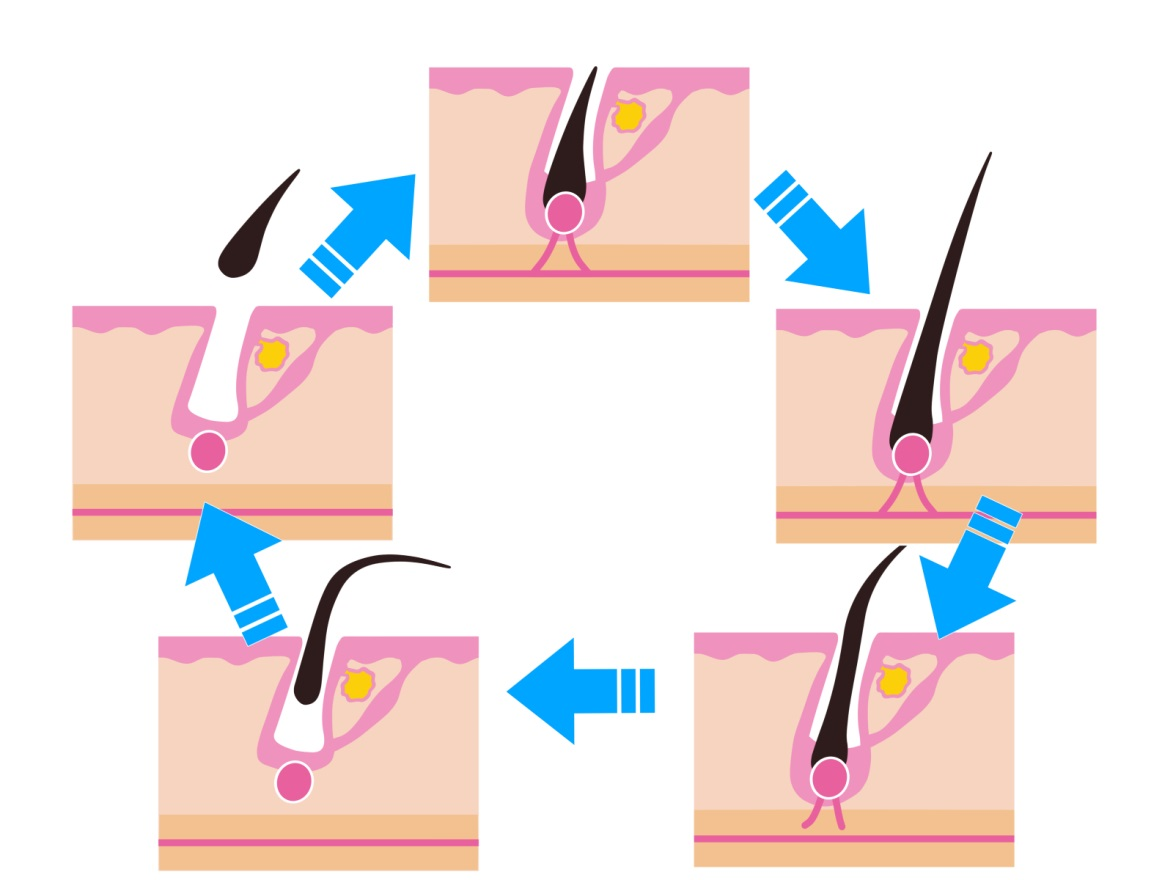
Hair regrowth from AGA treatment is less about “new hairs sprouting” and more a process of “restoring the thickness and length your hair should naturally have, by returning a shortened hair cycle to normal.” Understanding this distinction is the first step to correctly interpreting your treatment progress.
Healthy hair repeats a cycle of “anagen (growth phase, 2-6 years) then catagen (regression phase, 2-3 weeks) then telogen (resting phase, 3-4 months).” However, as AGA progresses, the action of dihydrotestosterone (DHT) shortens the growth phase to a few months or less than a year. Hair falls out before it can grow sufficiently thick and long, leaving only thin, short, vellus-like hairs.
AGA medications promote hair growth via two pathways. (1) Finasteride and dutasteride suppress the production of DHT, halting the shortening of the growth phase. (2) Minoxidil directly stimulates the dermal papilla cells, forcibly moving resting-phase hair follicles into the growth phase. When these two work together, thinned hairs grow thick again and dormant hair follicles wake up.
Two to four weeks after starting AGA treatment, about 30% of patients experience a “temporary increase in shedding.” This phenomenon is called “dread shedding (initial shedding)”, and it is evidence that the medication is working properly. More than a few people panic and stop taking their medication, but this is in fact a sign of treatment success.
When minoxidil is administered, old hair follicles in the resting phase are forcibly moved into the growth phase. At this time, because a new hair starts growing deep within the pore, the old hair is pushed out and falls. It looks as though shedding has increased, but what is actually happening is an “acceleration of turnover.”
There is individual variation, but it typically peaks at 2-3 weeks in and settles within 1-2 months. Normal shedding of 50-100 hairs per day can increase to as much as roughly 150-200 hairs. The hairs that fall are mainly thin, short hairs (hairs that did not finish growing), and they are most noticeable when washing your hair or using a hairdryer.
Concluding “it isn’t working” and stopping medication on your own judgment is the single most important thing to avoid. If shedding continues for more than 3 months, if it is severe enough that the scalp is widely visible, or if it is accompanied by redness or itching of the scalp, please consult our clinic. With an appropriate examination, the medication can be adjusted.
Once the dread shedding period has passed, many people start to see vellus hair growth from around the 3-month mark. From here, you enter the phase where you can feel the results of treatment.
Soft, fluffy vellus hairs become visible around the hairline and crown. Over the following months, this vellus hair gradually grows thicker and longer. Many people still feel “the area of thinning hasn’t changed,” but this is a period when change is definitely occurring at the level of the hair follicle. If you take a magnified photo with your smartphone camera under bright light, you can confirm the presence of vellus hair.
The vellus hairs that had grown earlier become thicker, while new vellus hairs also begin to grow in parallel. As each individual hair gradually thickens, this “vellus-to-terminal hair transformation” progresses, and a growing number of people get the impression that overall hair density has increased. People begin to notice changes such as their hair being easier to style after using a hairdryer, or spending more time looking in the mirror.
Month 6 is a milestone at which many patients feel “I’m glad I got treatment.” Changes such as the hairline becoming more even, less scalp showing through at the crown, and the hair as a whole gaining firmness and body reach a level that can be confirmed even through objective photo comparison. However, for those with severe progression (Hamilton-Norwood V or above), change may still be modest at the 6-month point, so continuing beyond 12 months is important.
Even if you do not feel an effect during this period, we do not recommend changing treatment before 6 months. Many international guidelines (the Japanese Dermatological Association, the American AAD, and others) state that the efficacy of AGA medication should be judged at a minimum of 6 months, and preferably after 12 months. Continuing without rushing is the single greatest condition for treatment success.
From 6 months onward is the period when changes in volume become obvious to everyone. By the time you reach 12 months, comparing a photo from before treatment with the present, many people are surprised by the dramatic change.
By around this time, the newly grown hairs have grown thick and long, and overall volume begins to stabilize. A growing number of people feel changes in daily life – their styling lasts longer, they have more hairstyle options, and they can go out without wearing a hat.
The amount and density of hair at the point past 12 months (one year) serves as a guide to the level of improvement achievable with that treatment plan. If you want to aim for further improvement from here, we consider changing or adding medication (such as switching to dutasteride). If the goal is to maintain the current state, the decision is to continue with the current plan.
Improvement after 12 months becomes gradual, and most people enter a “maintenance” phase. From this period, while preserving hair quality and density, the overall optimization with lifestyle factors such as daily hair care, nutrition, and sleep becomes important.
AGA treatment is a treatment whose effect is maintained through continuation. Unfortunately, if you stop taking your medication, AGA progression will resume over time. Correctly understanding this fact is essential when planning treatment.
When you stop taking medication, DHT production resumes from about 3 months later, and AGA progression begins again. Newly grown hairs gradually thin, and within 3-6 months your condition approaches its pre-treatment state. Considering that the volume gained through treatment is a result built up over 12 months from the start of treatment, the value of continuation is clear.
We often hear concerns such as “I’m worried about the cost of taking medication long term,” but at Men’s Care Clinic we offer treatment plans you can continue from around 10,000 yen per month, and once you enter the maintenance phase it is also possible to switch to an even more affordable plan. Considering the hair quality gained through treatment and the psychological and social impact it brings, it can be called a cost-effective investment.
At the core of AGA treatment are two classes of medication: “finasteride (or dutasteride)” and “minoxidil.” Because they have different mechanisms of action, combining them can be expected to produce a synergistic effect.
Classified as 5-alpha-reductase inhibitors, they block the production of DHT. Finasteride inhibits only type II 5-alpha-reductase (DHT suppression rate of about 70%), while dutasteride inhibits both type I and type II (DHT suppression rate of about 90%). They are highly effective at halting the progression of hair loss and serve as the foundation of AGA treatment.
It directly stimulates the dermal papilla cells, improves blood flow, and moves resting-phase hair follicles into the growth phase. There are oral and topical types (such as Rogaine), and our clinic determines the prescription after evaluating the patient’s scalp condition and risk of side effects. If finasteride is the foundation of “maintaining the current state,” think of minoxidil as the driver of “new hair growth.”
Compared with single-drug treatment, multiple clinical studies have shown that the combination of finasteride and minoxidil is superior in both the speed of felt hair regrowth and the degree of improvement. Our clinic adopts a policy of starting treatment with this basic set first, then adjusting according to the efficacy assessment at the 12-month point.
Men’s Care Clinic offers a progress-monitoring program that makes the time to felt hair regrowth “visible.” With follow-ups every 3 months and scalp photography, you can proceed with treatment while confirming objective change.
At the 3-month, 6-month, and 12-month milestones, we conduct scalp photography, an interview, and a doctor’s examination. Changes that are hard to notice on your own are clearly visualized through chronological photo comparison. It is also a service that directly helps maintain the motivation to continue treatment.
From the first visit through to ongoing prescriptions, everything can be completed online. There is no need to visit in person, and you can receive care from anywhere in the country. Prescription medication is delivered to your home. We provide a treatment environment that is easy to continue even for those for whom commuting to a clinic is difficult due to work or family circumstances.
The doctors at Men’s Care Clinic consist solely of experienced specialists well-versed in AGA treatment. We individually propose the optimal treatment plan according to each patient’s scalp condition, age, lifestyle, and the goal they wish to achieve.
AGA TREATMENT
In a free first consultation, we will guide you to the medication that suits you and a realistic timeline for hair regrowth.
Online consultations available; nationwide delivery.
A. As a guide, felt vellus hair growth takes 3-4 months, a change in hair density 6 months, and a clear gain in volume 12 months. There is individual variation, but many patients feel change along this timeline. Given the physiological workings of the hair cycle, you cannot expect a major change in less than 3 months.
A. That is a normal phenomenon called “dread shedding (initial shedding),” and it is evidence that the medication is working. It is seen in about 30% of people and usually settles within 1-2 months. Do not stop your medication on your own judgment – please continue. If it lasts more than 3 months or the shedding is extreme, consult a doctor.
A. International guidelines state that the efficacy of AGA medication should be judged at a minimum of 6 months, and preferably after 12 months. Even if there is little change at the 6-month point, there are many cases where improvement is seen by continuing to 12 months. However, if side effects appear or progression clearly does not stop, consult a doctor. We will consider changing or adding medication.
A. About 3 months after stopping medication, DHT production resumes and AGA progresses again. Over 3-6 months, your condition approaches its pre-treatment state. AGA treatment is a treatment that assumes continuation. Continuing long term with a manageable treatment plan is the only way to maintain the hair quality you have gained.
A. Yes, they can be used together. In fact, multiple clinical studies have shown that combined use produces a higher hair-growth effect than a single drug. There is a synergistic effect of stopping hair loss with finasteride while promoting hair growth with minoxidil. Our clinic proposes this combination as a basic set.
A. Dread shedding is a phenomenon seen in about 30% of people, and treatment is progressing normally even if it does not occur. The presence or absence of dread shedding has no direct correlation with treatment effectiveness. Please continue treatment with peace of mind. The effect is judged by changes from the 3-month mark onward.
A. At Men’s Care Clinic, we conduct scalp photography at the 3-month, 6-month, and 12-month milestones. Through comparison via fixed-point observation, you can objectively confirm changes that are hard to notice on your own. At home as well, regularly photographing the crown and hairline with your smartphone in a bright place is an effective way to keep a personal record of your treatment progress.
Supervised by: Men’s Care Clinic physician
This article has been supervised by a Men’s Care Clinic physician from the standpoint of medical accuracy and compliance with the latest guidelines. It was written and reviewed based on clinical experience in AGA treatment and on clinical research data from Japan and abroad.
* The content of this article is general medical information and is not a substitute for individual diagnosis or treatment. For treatment appropriate to your symptoms, always seek an examination by a doctor at a medical institution.
Medically reviewed by
Masashi MoritaPhysician
This article has been reviewed by a doctor for medical accuracy. Individual symptoms are assessed by a doctor at consultation.
AGA
Related Articles
2026/05/29 AGA AGA Treatment and Gray Hair: Does It Increase or Decrease Gray Hair? (Physician-Supervised)
2026/05/05 AGA Does Masturbation Cause Hair Loss? 3 Myths Debunked by Doctors
2026/05/05 AGA How to Choose an AGA Clinic: 5 Criteria & 10-Question Checklist | Doctor-Reviewed
2026/04/24 AGA Do You Have to Take AGA Medication for Life? Duration, Tapering & Cost | Men’s Care Clinic
2026/04/21 AGA At What Age Should You Start AGA Treatment? Effects by Decade from 20s to 50s, Explained by a Physician
2026/04/19 AGA Finasteride vs Minoxidil for AGA: Differences, Combination Therapy & Side Effects | Doctor-Reviewed
2026.05.29
AGA
AGA Treatment and Gray Hair: Does It Increase or Decrease Gray Hair? (Physician-Supervised)
2026.05.05
AGA
Does Masturbation Cause Hair Loss? 3 Myths Debunked by Doctors
2026.05.05
AGA
How to Choose an AGA Clinic: 5 Criteria & 10-Question Checklist | Doctor-Reviewed
2026.04.24
AGA
Do You Have to Take AGA Medication for Life? Duration, Tapering & Cost | Men’s Care Clinic
2026.04.21
AGA
At What Age Should You Start AGA Treatment? Effects by Decade from 20s to 50s, Explained by a Physician
2026.04.19
AGA
Finasteride vs Minoxidil for AGA: Differences, Combination Therapy & Side Effects | Doctor-Reviewed



 Hair Loss (AGA)