
.png) Book online
Book online
 Book via LINE
Book online
Book via LINE
Hair Removal

This article is created under the medical supervision of Men’s Care Clinic physicians. The information is based on medical evidence, but please consult a physician for individual symptoms.

Here is what to know about having hair removal done at a medical clinic. Medical laser hair removal meets the FDA (U.S. Food and Drug Administration) definition of permanent hair reduction, and compared to esthetic IPL, it requires fewer sessions (8-10 for beard, 5-8 for body hair). Since physicians are on-site, any skin trouble can be addressed immediately, and it offers superior long-term cost performance.

I want to start men’s hair removal, but I do not know whether to choose medical or esthetic hair removal. Esthetic hair removal seems cheaper, but is it really effective? Many men have these kinds of questions.
The conclusion is simple: if you want to reach a state where hair truly stops growing back, medical hair removal (laser hair removal) is the only choice for men. Esthetic IPL is limited to hair reduction and suppression, and hair may grow back once you stop treatment. Medical laser hair removal, on the other hand, can destroy the hair follicle tissue itself, making it the only method that qualifies as permanent hair reduction as certified by the FDA (U.S. Food and Drug Administration).
In this article, we will comprehensively explain everything a man considering hair removal needs to know, centered on the three reasons we recommend medical hair removal: specific differences from esthetic hair removal, guidelines for sessions and costs per body area, types of lasers, and how to handle pain. The article has been updated from its initial 2021 publication to the latest 2026 information, so please read to the end.



When considering men’s hair removal, the first thing to understand is that medical hair removal (clinic) and esthetic hair removal (salon) are fundamentally different procedures. Despite the similar names, the equipment used, practitioner qualifications, and results differ significantly.
The major distinction is whether the procedure is performed at a medical institution. Medical hair removal is a medical procedure that can only be performed at clinics (medical facilities) with physicians on staff, using high-output lasers. Esthetic hair removal is performed at esthetic salons by staff without medical qualifications, using low-output light (IPL).
The table below lets you see the main differences between medical and esthetic hair removal at a glance.
| Comparison Item | Medical Hair Removal (Clinic) | Esthetic Hair Removal (Salon) |
|---|---|---|
| Facility Type | Medical institution (clinic) | Esthetic salon |
| Practitioner | Physician or nurse (national qualification) | Esthetician (private qualification) |
| Equipment | Medical laser (high output) | IPL / photoepilation (low output) |
| Hair Removal Effect | Permanent hair reduction (FDA-certified) | Hair reduction / suppression (temporary) |
| Sessions for Beard | 8-10 sessions | 20-30+ sessions |
| Sessions for Body Hair | 5-8 sessions | 12-18+ sessions |
| Effect per Session | High (destroys follicular tissue) | Low (only damages the follicle) |
| Pain | Somewhat strong (anesthetic cream available) | Relatively mild |
| Skin Trouble Response | Immediate physician response and prescription possible | Referral to partner medical facility only |
| Total Cost (Full Beard) | Approx. JPY 100,000-200,000 | Approx. JPY 150,000-300,000 (higher with more sessions) |
| Anesthesia | Available (medical procedure) | Not available |
As this comparison shows, even though esthetic hair removal appears cheaper per session, the required number of sessions is 2-3 times greater, so the total cost is often lower with medical hair removal.
According to the American Electrology Association (AEA), permanent hair reduction is defined as a regrowth rate of 20% or less one month after the final treatment. To meet this standard, the tissues that produce hair (hair matrix cells, dermal papillae) must be destroyed, which constitutes a medical procedure.
IPL devices used in esthetic salons have limited output and lack the ability to completely destroy follicular tissue. They can thermally damage the follicle to temporarily suppress hair growth, but over time, the hair matrix cells recover and hair grows back.
In fact, in 2001, Japan’s Ministry of Health, Labour and Welfare issued a notice (Medical Bureau Notification No. 105) stating that irradiating the hair root area with laser light or other light of powerful energy, regardless of whether the device is a medical device, to destroy the dermal papilla, sebaceous gland openings, etc., constitutes a medical procedure. In other words, treatment capable of producing permanent hair reduction can legally only be performed at medical institutions.
Compared to women, men’s body hair has the characteristic of being thicker with deeper-rooted follicles. Beard hair in particular is classified as terminal hair, the thickest and most coarse type of body hair, with follicle depths reaching 3-4 mm.
Because IPL used in esthetic salons has weak output, sufficient energy has difficulty reaching these deep follicles. As a result, reviews of esthetic hair removal often include complaints like I went for dozens of sessions and my beard did not reduce.
In contrast, medical lasers have high output that can deliver energy deep into the follicle. Because thick, deep hair like men’s beards has higher melanin absorption efficiency, thick, coarse men’s hair is actually the ideal target for medical lasers.

The biggest reason we recommend men’s medical hair removal is that you can obtain the permanent hair reduction effect in which hair does not regrow after treatment is complete.
The FDA (U.S. Food and Drug Administration) has certified medical laser hair removal for Permanent Hair Reduction. Specifically, clinical data confirms that after completing the prescribed number of sessions, 67% or more of hair volume is permanently reduced.
Permanent hair reduction does not mean not a single hair will ever grow back, but it reaches a level where most visible unwanted hair disappears and self-care becomes unnecessary. Being freed from daily shaving, wearing T-shirts and shorts with confidence – these everyday changes are a benefit unique to medical hair removal.
The principle of medical laser hair removal is based on a mechanism called selective photothermolysis. Laser light is selectively absorbed by the melanin pigment in hair and converted into heat energy, which thermally destroys the hair matrix cells and dermal papilla that produce hair.
Because surrounding skin tissue contains little melanin, it absorbs very little laser energy. This allows the procedure to pinpoint only the hair follicle while minimizing damage to the skin.
Once destroyed, hair matrix cells do not regenerate, so hair stops growing from that follicle. However, since not all hair is in the growth phase at the same time, multiple sessions are required to sequentially treat hair in different growth cycles.
Medical hair removal results become visibly apparent 2-3 weeks after the first session. A phenomenon called pop-out occurs, where the irradiated hair sheds off gradually, and many people feel the amount of hair has clearly decreased.
After 3 sessions, hair volume is roughly halved. After 5 sessions, the frequency of self-care is dramatically reduced, and after 8-10 sessions, the skin reaches a nearly smooth state.
On the other hand, esthetic hair removal has milder results per session, so it takes 2-3 times as many sessions to achieve the same feel. Moreover, with esthetic hair removal, hair regrows if treatment is discontinued, requiring continuous visits. Once you start, there is no end with esthetic hair removal, while the goal is clear with medical hair removal.
At Men’s Care Clinic, we use GentleLase Pro from Syneron Candela. This device is equipped with an alexandrite laser (wavelength 755 nm) and is one of the most widely used hair removal lasers at medical institutions worldwide.
GentleLase Pro is particularly strong for men’s beard hair removal, delivering sufficient energy even to thick, deep hair follicles. There is no need to worry that the power will not be enough for coarse men’s hair.

The second reason we recommend men’s medical hair removal is that physicians and nurses perform the procedures and can respond on the spot to any trouble.
Since hair removal is a procedure that applies heat energy to the skin, the risk of burns or folliculitis is not zero. What matters is how to respond when trouble occurs, and this is where there is a decisive difference between medical and esthetic hair removal.
Medical hair removal clinics have the following safety management systems in place.
Japan’s National Consumer Affairs Center receives many complaints about esthetic hair removal every year. The main types of complaints are as follows.
Since esthetic salons are not medical institutions, they cannot perform examinations or prescribe medication on the spot when trouble occurs. Remember that choosing esthetic hair removal solely because it is cheap carries the risk of ultimately incurring additional medical costs and time.
Men’s Care Clinic has established a medical collaboration with Toyosu Hospital (Showa University system). Even in the unlikely event of skin trouble that cannot be handled within the clinic, we can promptly refer patients to an advanced medical institution.
Additionally, we always conduct a physician’s consultation before treatment and set laser output to match each individual’s skin and hair type. During treatment, nurses monitor skin condition while performing irradiation, ensuring sufficient safety margins.
If redness or swelling occurs after treatment, aftercare including anti-inflammatory medication prescriptions is available free of charge. Medical hair removal is safe is a claim we can make precisely because of this kind of system.
Many people have the image that medical hair removal is expensive. Indeed, the cost per session is higher than esthetic hair removal. However, when comparing total cost and effectiveness, medical hair removal has superior cost performance in most cases.
The reason is clear: medical hair removal is completed in fewer sessions, keeping the total cost lower. Furthermore, once treatment is complete, maintenance is basically unnecessary, so no additional costs arise.
The table below shows the guideline number of sessions and costs for men’s medical hair removal by body area. Individual differences exist, but please use this as a general market reference.
| Area | Medical Hair Removal Sessions | Esthetic Hair Removal Sessions | Medical Hair Removal Cost Estimate |
|---|---|---|---|
| Full Beard | 8-10 sessions | 20-30+ sessions | Approx. JPY 100,000-200,000 |
| Full Body (excluding beard) | 5-8 sessions | 12-18+ sessions | Approx. JPY 200,000-400,000 |
| VIO | 5-8 sessions | 12-18+ sessions | Approx. JPY 80,000-150,000 |
| Arms (upper + lower) | 5-6 sessions | 10-15 sessions | Approx. JPY 50,000-100,000 |
| Legs (upper + lower) | 5-6 sessions | 10-15 sessions | Approx. JPY 80,000-150,000 |
| Underarms | 5-6 sessions | 10-12 sessions | Approx. JPY 30,000-50,000 |
| Chest and Abdomen | 5-8 sessions | 10-15 sessions | Approx. JPY 50,000-100,000 |
For example, a full beard requires 8-10 sessions with medical hair removal, while esthetic hair removal requires 20-30 or more sessions. Even if the cost per session at an esthetic salon is half, the total cost will be 1.5 times higher if the number of sessions is three times as many. In addition, since esthetic hair removal may allow hair to grow back even after completion, the cost of additional treatments must also be considered.
What is often forgotten when considering the cost of hair removal is the cost and time required for self-care.
For example, let’s calculate the cost of daily beard shaving. Electric shaver replacement blades cost approximately JPY 5,000-10,000 per year, shaving foam about JPY 3,000 per year, and replacing the shaver body once every 2-3 years costs about JPY 10,000-20,000. This amounts to roughly JPY 10,000-20,000 per year, or JPY 100,000-200,000 over 10 years.
Furthermore, if it takes 10 minutes to shave your beard each morning, that is about 60 hours per year, or about 600 hours over 10 years – in other words, you spend about 25 days worth of time shaving your beard.
By using medical hair removal to permanently remove your beard, all these costs and time become unnecessary. The initial cost is high, but you quickly recoup your investment – this is the essence of medical hair removal cost performance.
Many people feel anxious about paying hundreds of thousands of yen for a course contract. That feeling is completely understandable.
Men’s Care Clinic adopts a pay-per-visit system that does not require a course contract. Since you pay per session, you have the advantage of being able to decide for yourself whether to continue based on the results.
While many clinics have 5-session courses or 10-session courses as their standard, our ability to offer pay-per-visit is precisely because we are confident in the quality and effectiveness of our treatment. The pay-per-visit system is especially recommended for those who feel anxious about starting men’s medical hair removal for the first time.
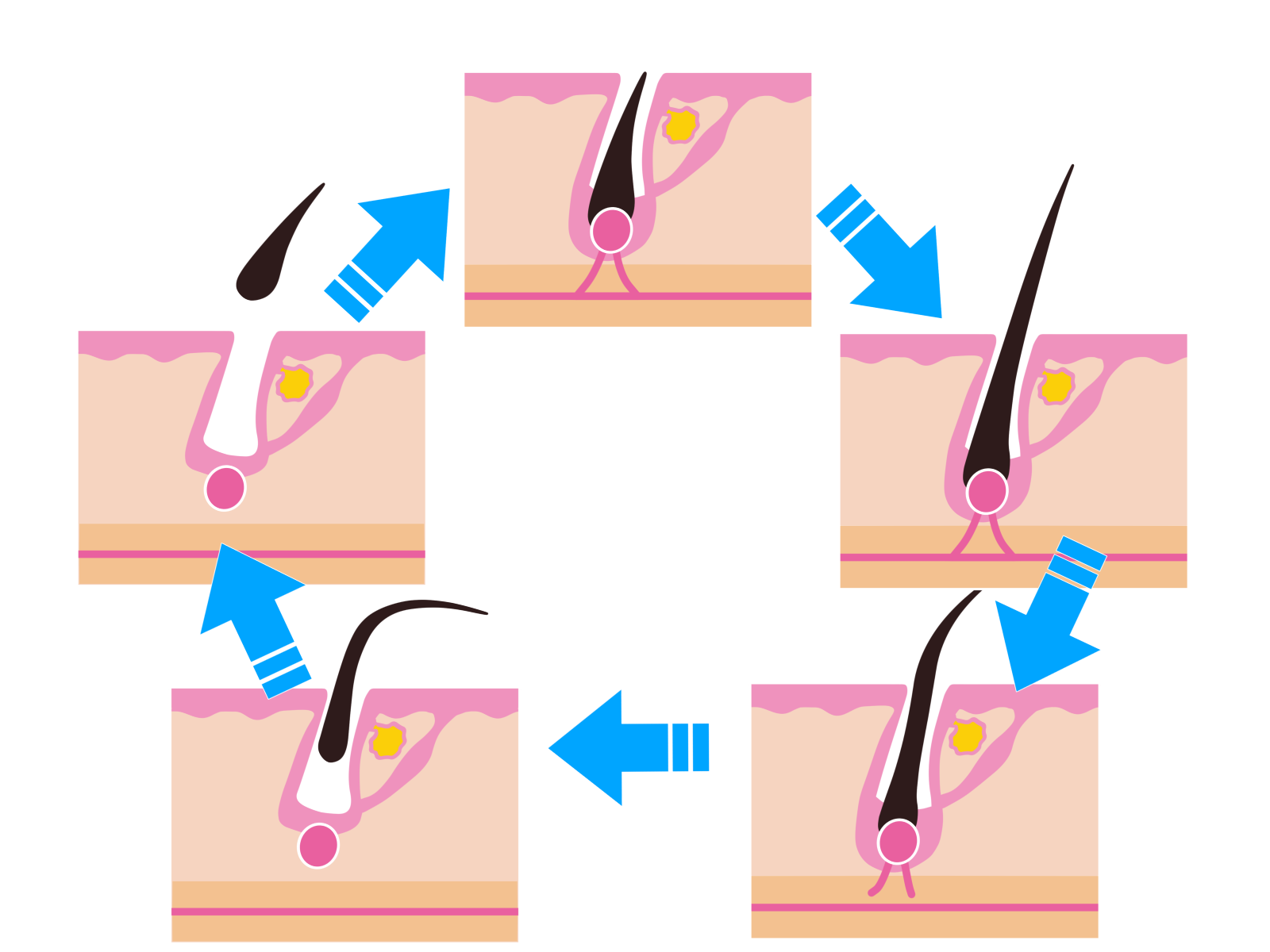
Why does not hair removal end in one session? Why do I need to visit every few weeks? The answer to these questions lies in the hair cycle.
Understanding the hair cycle helps you understand why a certain number of sessions and visit intervals are required, allowing you to proceed with hair removal efficiently.
All body hair repeats growth and shedding through the following three phases.
Importantly, only about 20% of all hair is visible on the skin surface. The remaining 80% is in the catagen or telogen phase, waiting beneath the skin for the next growth.
In other words, only about 20% of hair can be treated with a single laser irradiation, so multiple sessions are required to treat all hair.
Hair cycle length differs by area. To maximize efficacy, it is important to receive treatment when the most hair is in the growth phase.
| Area | Anagen Ratio | Hair Cycle Length | Recommended Treatment Interval |
|---|---|---|---|
| Beard | Approx. 20% | Approx. 4 months to 1 year | Every 6-8 weeks |
| Underarms | Approx. 30% | Approx. 4-5 months | Every 4-6 weeks |
| Arms and Legs | Approx. 20% | Approx. 3-6 months | Every 6-8 weeks |
| VIO | Approx. 30% | Approx. 4 months to 1 year | Every 6-8 weeks |
| Chest and Abdomen | Approx. 20% | Approx. 6 months to 1 year | Every 8-10 weeks |
At Men’s Care Clinic, during the initial consultation, we examine your skin and hair type, and then inform you of the optimal treatment interval and guideline number of sessions for you. Rather than an opaque unlimited visits plan, the strength of medical hair removal is the ability to establish a treatment plan with a clear goal.
I have heard medical hair removal is painful, but how much does it really hurt? – this is one of the most frequently asked questions in men’s hair removal.
To be honest, medical hair removal does involve some pain. However, the pain is not unbearable, with many people describing it as like being snapped with a rubber band. Also, the pain decreases with each session.
The way pain is felt varies significantly by area. Areas where hair is thick and dense, or where skin is thin, tend to feel more pain.
| Area | Pain Level | Type of Pain |
|---|---|---|
| Beard (under nose, chin) | Strong | Snapping pain like being flicked. Strongest on the first session, decreases with each subsequent session. |
| VIO | Somewhat strong | Pain second only to beard. The I-line in particular is sensitive. |
| Underarms | Moderate | Prickly sensation. Small area, so treatment ends quickly. |
| Legs (shins) | Mild to moderate | Large area irradiated, but parts close to bones can be somewhat painful. |
| Arms | Mild | Barely noticeable level. |
| Chest and Abdomen | Mild | Almost painless for those with less hair. |
Pain from medical hair removal can be dramatically reduced with the following methods.
At Men’s Care Clinic, we can prescribe anesthetic cream. If you are concerned about pain, please feel free to consult us during your counseling session. We believe it is our responsibility as a medical institution to provide hair removal that you do not have to endure.
There are multiple types of lasers used for medical hair removal, each with different wavelengths and characteristics. When choosing a clinic, it is important to check which laser equipment they use.
| Laser Type | Wavelength | Features | Best For |
|---|---|---|---|
| Alexandrite | 755 nm | Highest melanin absorption rate. Many models equipped with cooling systems, minimizing pain. Optimal for Japanese skin. | Thick, dense hair (beard, VIO, shin) |
| Diode | 800-940 nm | Longer wavelength, also suited for slightly deeper follicles. Two types: heat-accumulation (SHR) and thermal destruction. | Standard thickness hair, also vellus hair |
| Nd:YAG | 1064 nm | Longest wavelength, reaches the deepest follicles. Also compatible with tanned skin, but with stronger pain. | Deep-rooted hair, hyperpigmented areas |
For men’s hair removal, the alexandrite laser is considered the most effective. There are three reasons.
Men’s Care Clinic GentleLase Pro is the top-tier model of alexandrite laser. With its unique DCD cooling system, it achieves both high hair removal efficacy and pain reduction.
Medical hair removal has two irradiation methods: thermal destruction (shot method) and heat-accumulation (SHR method).
For thick, dense hair like men’s beard and VIO, thermal destruction is more effective. Heat-accumulation is better suited for vellus or fine hair, and it is ideal to use each method according to area and hair type.
For those who are new to medical hair removal and unsure what to expect, we will explain the procedure flow at Men’s Care Clinic step by step.
First, book a free consultation via the web or by phone. You can choose from our three clinics: Shinbashi, Akihabara, or Omotesando, whichever is most convenient.
No special preparation is needed at booking. On the day, we ask that you shave the treatment area (self-care the day before), but if it is just a consultation, you can come as you are.
After arrival, a physician will confirm your skin type, hair type, and medical history, and determine the laser type and output settings. Please share any allergies, chronic conditions, or medications you are taking at this stage.
We will also hear about the areas you want to treat and the image of the finish (such as completely smooth or reduce the volume), and inform you of the guideline number of sessions and cost. You can freely decide whether to receive treatment after the consultation, so just wanting to hear about it is completely fine.
Gel is applied to the treatment area, and GentleLase Pro is used to deliver the laser. Treatment time varies by area, but the guidelines are as follows.
For those concerned about pain, anesthetic cream is applied before treatment (arrival 30 minutes before treatment is recommended). During irradiation, nurses frequently check in, and if pain is strong, they will adjust the output, so please do not hold back from speaking up.
After treatment, the irradiated area is cooled and anti-inflammatory moisturizer is applied. Redness may occur but usually subsides within 1-2 days. In the unlikely event of trouble, you can receive physician examination and medication prescriptions free of charge.
Post-treatment precautions are as follows.
The next treatment is scheduled 6-8 weeks later, matching the hair cycle. Payment is made per visit, and you pay only for one session treatment fee.
There are many clinics offering men’s medical hair removal, but Men’s Care Clinic has the following distinctive features.
1. Pay-Per-Visit System – Easy to Start Without Course Contracts
Men’s Care Clinic adopts a pay-per-visit system. There are no high-priced prepayments like 5-session course at XXX yen. You can attend at your own pace while confirming results, making it easy for first-timers to start. There are no penalties for quitting midway.
2. Three Tokyo Clinics – Shinbashi, Akihabara, Omotesando
We have clinics in three major areas of Tokyo. All are within walking distance from the nearest station, with excellent accessibility. Convenient for after-work or weekend visits, you can receive the same quality of treatment at any clinic. You can also receive treatment at different clinics based on availability.
3. GentleLase Pro Installed – Equipment Optimal for Men’s Coarse Hair
Syneron Candela GentleLase Pro is installed at all our clinics. With high hair removal efficacy from the alexandrite laser and pain reduction from the DCD cooling system, it is equipment optimal for men’s hair removal. It also has FDA certification reliability.
4. Free Consultation and Initial Visit
Consultations and initial visit fees are free. Even those who are still undecided or want to decide after hearing the details can visit without worrying about costs. After the consultation, you can freely decide whether to receive treatment. We never push for sales.
5. Medical Partnership with Toyosu Hospital (Showa University System)
Men’s Care Clinic is partnered with Toyosu Hospital, part of the Showa University system. In the unlikely event of skin trouble or if medical follow-up beyond hair removal is needed, we can promptly refer you to an advanced medical institution. The reassurance of having a university hospital safety net, even at a private practice clinic, is a major advantage.
6. Privacy Consideration as a Men’s-Only Clinic
Men’s Care Clinic is a men’s-only clinic. All visitors are male, and male staff handle interactions. For areas that are hard to discuss with others, such as VIO hair removal, same-sex staff allow for open consultation without hesitation.
If you want reliable hair removal results, you should choose medical hair removal. Medical laser hair removal destroys the follicular tissue to achieve permanent hair reduction (FDA-certified), while esthetic IPL is limited to hair reduction and suppression and hair may grow back once treatment stops.
Men’s body hair is thicker than women’s and has deeper follicles, making it realistically difficult to get sufficient results with the low-output light of esthetic salons. As the number of sessions increases, so does the total cost, so medical hair removal has superior long-term cost performance.
Men’s Care Clinic adopts a pay-per-visit system, allowing you to start from a single session without a course contract. Start with a free consultation and receive treatment plan recommendations based on your skin and hair type.
It varies by area, but 8-10 sessions is the guideline for full beard, and 5-8 sessions for body hair (arms, legs, underarms, etc.). Individual differences exist due to hair volume and hair type, so the actual number of sessions will be determined by a physician during your consultation.
The reason multiple sessions are required is the hair cycle. Only about 20% of all hair is visible on the skin surface, and only that growth-phase hair can be treated with a single irradiation. By spacing sessions with intervals, all hair is treated sequentially.
Men’s Care Clinic recommends treatment intervals of 6-8 weeks. For beard hair removal, 8 sessions is a guideline for about 1 year to 1.5 years of treatment duration.
Medical hair removal does involve some pain, but most people describe it as like being snapped with a rubber band. It varies by area; the beard (especially under the nose) and VIO tend to be more painful, while arms and chest are barely noticeable.
For those concerned about pain, anesthetic cream (lidocaine) can be applied. Additionally, our GentleLase Pro is equipped with a DCD cooling system that automatically eases pain by spraying cooling gas immediately before irradiation. As you accumulate sessions, hair volume decreases and pain also decreases.
The cost guideline for men’s medical hair removal is approximately JPY 100,000-200,000 for full beard (8-10 sessions) and JPY 200,000-400,000 for full-body hair removal (5-8 sessions). It varies by area and clinic, but compared to esthetic hair removal, while the per-session cost is higher, the total cost is often equivalent or even lower due to fewer sessions.
Men’s Care Clinic adopts a pay-per-visit system that does not require course contracts, so no high initial cost is needed. Consultations and initial visits are free, and payment is only for the treatment fee. You can confirm results one session at a time and decide whether to continue.
Medical laser hair removal is a treatment certified by the FDA (U.S. Food and Drug Administration) for Permanent Hair Reduction. Clinical data confirms that after completing the prescribed sessions, 67% or more of hair volume is permanently reduced.
However, permanent hair reduction does not mean not a single hair will ever grow back – very fine vellus hair may slightly regrow. That said, it reaches a level where most visible unwanted hair disappears and daily self-care becomes unnecessary. It does not return to normal when you stop like esthetic hair removal.
The hair cycle refers to the cycle hair repeats: anagen (growth) to catagen (regression) to telogen (resting). Medical lasers are only effective on anagen-phase hair, and only about 20% of all hair (the visible hair on the skin surface) is in the anagen phase.
Since only this 20% of anagen-phase hair can be treated in one session, you need to wait for the remaining hair to enter the anagen phase before the next treatment. This is why multiple visits at 6-8 week intervals is required. Receiving treatment at the appropriate timing matched to the hair cycle is the most efficient path to hair removal.
The number of men receiving VIO hair removal is increasing year by year, and at Men’s Care Clinic, VIO is one of the popular areas. Treatment is performed in completely private rooms, and male nurses handle it, so there is no concern about being seen by female staff.
During treatment, towels are used to expose only the necessary parts, so you are never completely unclothed. Most patients say the embarrassment was only for the first few minutes, then I got used to it. From improved hygiene and cleanliness, we have received many comments that partner reviews are also positive.
Since medical laser hair removal is a procedure that applies heat energy to the skin, the risk of burns is not zero. However, the latest laser equipment is equipped with cooling systems, and with appropriate output settings and treatment procedures followed, the risk is extremely low.
In the unlikely event of burns or inflammation, medical hair removal clinics can examine on the spot and prescribe anti-inflammatory or topical steroid medications. This is a major advantage not available at esthetic salons. Men’s Care Clinic provides post-treatment aftercare (examination and medication prescriptions) free of charge.
GentleLase Pro is medical hair removal equipment manufactured by Syneron Candela, equipped with an alexandrite laser (wavelength 755 nm). It is one of the most widely used hair removal lasers at medical institutions worldwide and has FDA certification.
Its biggest feature is the DCD (Dynamic Cooling Device) cooling system, which sprays cooling gas immediately before laser irradiation to protect the skin. This significantly reduces the risk of pain and burns while maintaining high hair removal efficacy. It is particularly effective on thick, dense hair like men’s beards.
It depends on the clinic, but clinics offering pay-per-visit are increasing. Men’s Care Clinic has a complete pay-per-visit system with no course contracts required. With payment per session, you can freely decide whether to continue while confirming results.
Set contracts like 5-session courses or 10-session courses may look advantageous at first glance but carry risks like losing money if results do not appear and trouble with mid-course cancellation. With pay-per-visit, you can start medical hair removal without such risks.
A common regret case in men’s hair removal is the pattern of attended esthetic hair removal but saw no results, ended up switching to medical hair removal (wasted time and money). Choosing medical hair removal from the start prevents this kind of regret.
Another regret is completely removed beard but later wanted to grow it back. Since medical hair removal is permanent, you cannot restore the original state after treatment completion. There is also the option of reducing volume rather than completely smooth, so please thoroughly communicate your desired finish image at the consultation.
The day before treatment, shave the irradiation area with a razor (tweezers and wax cannot be used). Since tanned skin may prevent laser irradiation, thoroughly implement UV protection starting 2 weeks before treatment.
After treatment, redness or mild swelling may occur on the irradiation area but usually subsides within 1-2 days. From the day of treatment through the next day, avoid strenuous exercise, baths (showers are OK), and alcohol, and avoid sunburn for about 2 weeks. Thorough moisturizing speeds skin recovery.
In this article, we comprehensively explained, centered on the three reasons men should choose medical hair removal, the differences from esthetic hair removal, costs, pain, and types of lasers.
Organizing the points, here is what we covered.
Choosing esthetic hair removal with reasons like it is cheaper or seems less painful may ultimately result in more sessions, taking both more time and cost. Choosing medical hair removal from the start is the smartest decision.
At Men’s Care Clinic, consultations and initial visits are free, and pay-per-visit allows you to try from just one session. Male staff will serve you at our three clinics: Shinbashi, Akihabara, and Omotesando. Please feel free to consult us.
Related pages:
Medically reviewed by
Masashi MoritaPhysician
This article has been reviewed by a doctor for medical accuracy. Individual symptoms are assessed by a doctor at consultation.
Hair Removal
Related Articles
2026/05/30 Hair Removal Is Medical Nose-Hair Removal Possible for Men? A Physician-Supervised Guide to Benefits, Risks, Sessions, Pain, and Pricing
2026/05/30 Hair Removal Athlete Hair Removal: Purpose and Benefits by Sport | Physician-Supervised Medical Hair Removal Guide
2026/05/29 Hair Removal Men’s Nursing-Care Hair Removal: What Age to Start, VIO Medical Hair Removal Benefits, Sessions & Pricing
2026/05/29 Hair Removal How Many Sessions of Medical Laser Hair Removal Until Results? By Body Area
2026/05/28 Hair Removal Heat-Destruction vs Accumulation Laser Hair Removal | HR vs SHR
2026/05/28 Hair Removal Mens Brazilian/VIO Laser Hair Removal: 2026 Guide
2026/05/27 Hair Removal Will You Regret Mens Full Body Hair Removal? 7 Common Patterns and a Doctors Guide to Choosing the Right Clinic [2026]
2026/05/27 Hair Removal Medical Laser vs Salon vs Home Hair Removal: Effectiveness, Cost, and Duration Compared [2026]
2026/05/26 Hair Removal Medical Laser Hair Removal|How It Works, 3 Laser Types Compared, Sessions Required (2026 Guide)
2026/05/23 Hair Removal Men’s Medical Laser Hair Removal: Complete Guide to Cost & Sessions
2026.05.30
Hair Removal
Is Medical Nose-Hair Removal Possible for Men? A Physician-Supervised Guide to Benefits, Risks, Sessions, Pain, and Pricing
2026.05.30
Hair Removal
Athlete Hair Removal: Purpose and Benefits by Sport | Physician-Supervised Medical Hair Removal Guide
2026.05.29
Hair Removal
Men’s Nursing-Care Hair Removal: What Age to Start, VIO Medical Hair Removal Benefits, Sessions & Pricing
2026.05.29
Hair Removal
How Many Sessions of Medical Laser Hair Removal Until Results? By Body Area
2026.05.28
Hair Removal
Heat-Destruction vs Accumulation Laser Hair Removal | HR vs SHR
2026.05.28
Hair Removal
Mens Brazilian/VIO Laser Hair Removal: 2026 Guide
2026.05.27
Hair Removal
Will You Regret Mens Full Body Hair Removal? 7 Common Patterns and a Doctors Guide to Choosing the Right Clinic [2026]
2026.05.27
Hair Removal
Medical Laser vs Salon vs Home Hair Removal: Effectiveness, Cost, and Duration Compared [2026]
2026.05.26
Hair Removal
Medical Laser Hair Removal|How It Works, 3 Laser Types Compared, Sessions Required (2026 Guide)
2026.05.23
Hair Removal
Men’s Medical Laser Hair Removal: Complete Guide to Cost & Sessions



 Hair Loss (AGA)